
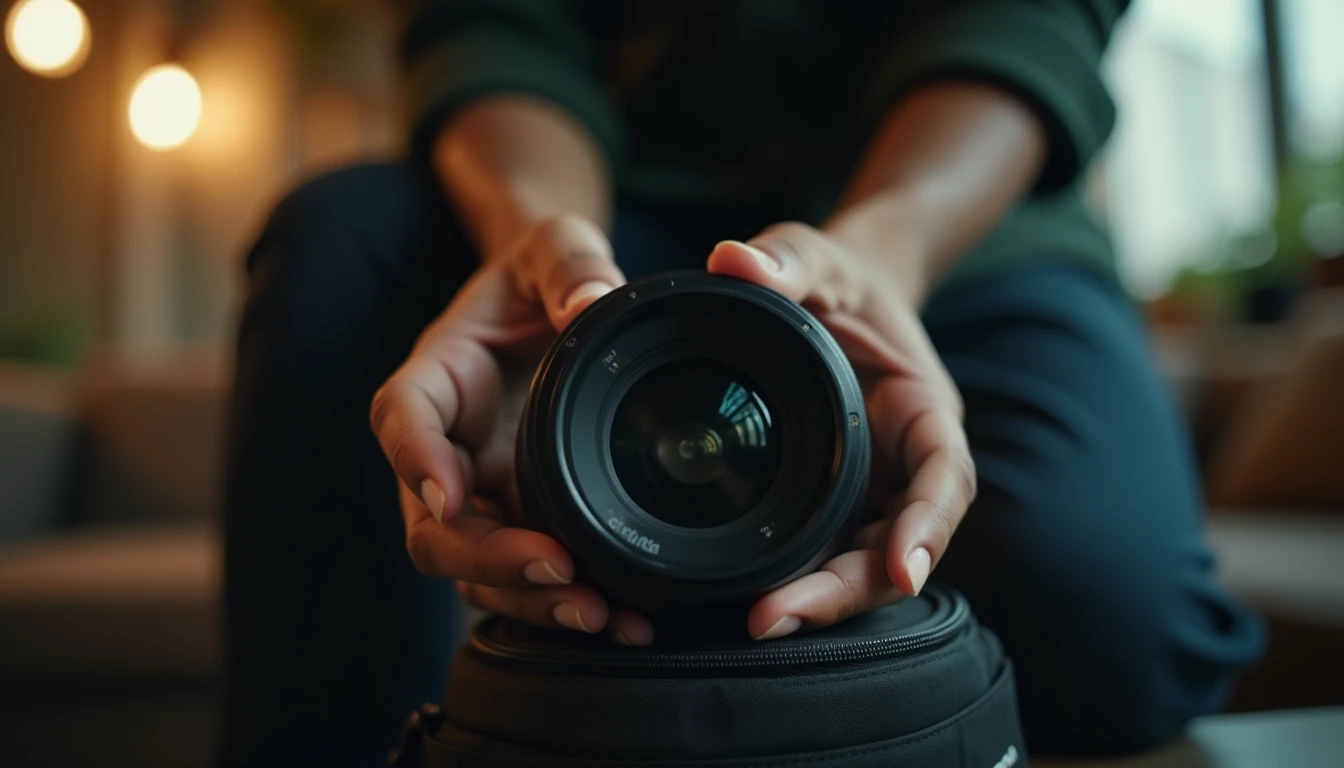
Last month, I was helping a friend who had just started out as a freelance videographer in Semarang. He had a pretty good mirrorless camera, but he was still using the kit lens it came with. "Bro, why don’t my videos look as creative as everyone else’s? It feels like something’s missing visually," he complained, showing me an interview recording where the image felt flat.
This is a common problem. The jump from photography as a hobby to professional video often gets stuck on choosing the right lens. A lens isn’t just a tool for capturing images; it’s an extension of your eye, it shapes your visual aesthetic, and it can even affect how you work on set. Pick the wrong lens and your video won’t reach its potential, even when the budget was there.
Let’s break down, one by one, what you need to understand so you don’t make the wrong call when buying a lens for video production. This isn’t about brands or the most expensive price tag, it’s about what fits your needs and your production style.
Understanding Focal Length: Your Visual Point of View
Focal length, measured in millimeters (mm), is one of the most fundamental elements of a lens. Put simply, it determines how wide or narrow a view the lens can capture. Your choice of focal length will strongly shape the visual story you want to tell.
For video, we can split it into three main categories:
- Wide-Angle (usually below 35mm on full-frame): A wide lens captures a very broad field of view. It’s very useful for an establishing shot (showing the location or overall context of a scene), capturing the grandeur of the architecture in Kota Lama, or when you’re working in a tight space like inside a car or a small room. The downside is that it can cause distortion (a curving effect) at the edges of the frame if you’re not careful, and it makes subjects feel farther away. I once used a 16mm lens on a Lumix S5 to record the atmosphere inside a packed café in the Tembalang area, and it was such a relief to fit so many elements into one frame.
- Normal (around 35mm – 50mm on full-frame): Lenses at this focal length give the view closest to what the human eye sees. The result feels natural, not too wide and not too tight. They’re ideal for interviews, everyday scenes, or when you want the audience to feel 'present' in the scene. The 50mm is a classic, very versatile choice.
- Telephoto (above 70mm on full-frame): A telephoto lens 'magnifies' distant subjects and narrows the view. It’s very useful for isolating a subject, creating background compression (making the background look closer to the subject), or recording action from a safe distance without getting in the way. Picture recording a music performance from the back of the crowd: a telephoto lens is the go-to solution. This compression effect is also often used in company profile videos that want to show a subject against a background that feels 'dense' and close.
Aperture: Controlling Light and Depth
Aperture is the opening inside the lens that controls how much light reaches the camera sensor. It’s measured in f-stop numbers (for example f/1.8, f/2.8, f/5.6). A smaller f-stop number (like f/1.8) means a wider opening, while a larger number (like f/5.6) means a narrower opening.
Aperture has two crucial jobs in video production:
- Light Control: A wide opening (small f-stop) lets more light in, which helps a lot when shooting in low light at night or indoors without adequate lighting. Lenses with wide apertures like f/1.4 or f/1.8 are often called 'fast lenses'.
- Depth of Field (DoF): This is the area of the image that appears in focus. A wide opening (small f-stop) produces a thin depth of field (shallow depth of field). That means only the subject in focus is sharp, while the background goes blurry (the bokeh effect). This is very effective for isolating a subject, making a video look more cinematic, and guiding the viewer’s attention. On the other hand, a narrow opening (large f-stop) produces a deep DoF, keeping the whole scene sharp from front to back, which suits landscapes or moments when every detail matters.
I once shot an interview in an office in Semarang with poor lighting. With a 50mm f/1.8 lens, I could get a bright enough image without pushing the ISO too high, and the bokeh made the interviewee 'pop' out of the busy background.
Prime vs Zoom Lenses: Flexibility vs Quality
There are two main types of lenses you need to know: prime lenses and zoom lenses.
-
Prime Lenses: These lenses have a fixed focal length (for example 35mm, 50mm, 85mm). You can’t change the focal length, so to change your framing, you have to move forward or backward. The main advantages of a prime lens are:
-
Sharper Image Quality: Generally, prime lenses are designed with simpler but precise optics, producing sharper, more detailed images.
-
Wide Apertures: Many prime lenses offer very wide apertures (f/1.8, f/1.4, even f/1.2), which are great for low light and shallow depth of field.
-
More Compact and Lighter: Compared with zoom lenses of similar quality, primes tend to be smaller and lighter.
-
More Affordable: For the same optical quality, a prime lens is often cheaper than a zoom lens.
-
Zoom Lenses: These lenses have an adjustable focal length range (for example 24-70mm, 70-200mm). Their advantages are:
-
High Flexibility: You can change your framing quickly without moving, which is very practical when shooting events or fast-moving coverage.
-
Practical on Location: They save time and energy because you don’t need to keep swapping lenses.
-
One Lens for Many Needs: A versatile zoom lens can cover a wide range of shooting scenarios.
The downsides of professional zoom lenses are that they tend to be expensive, they’re bigger, and their maximum aperture usually isn’t as wide as a prime’s (for example f/2.8 or f/4, not f/1.8).
Crucial Considerations for Video Production
Besides focal length and aperture, there are a few specific factors that matter for video production:
- Image Stabilization (IS/VR/OSS): This feature, whether in the lens (Optical IS) or in the camera body (In-Body IS – IBIS), helps a lot in reducing shake while recording video, especially if you’re recording on the move or using a telephoto focal length. Without stabilization, footage can look shaky and unprofessional. I always prioritize a camera with good IBIS, and if the lens has stabilization too, that’s a big bonus. The Lumix S5 I use has very capable IBIS.
- Focus Breathing: This is when the field of view shifts slightly as you change focus from one point to another. In video, this can be very distracting and look unprofessional. Lenses designed specifically for video usually minimize or eliminate focus breathing. Regular photo lenses often still have this effect.
- Smooth Focus Ring: A good video lens has a focus ring that is smooth, responsive, and has a long rotation (long focus throw). This lets the focus operator make precise, gentle focus shifts, especially when using an external follow focus. Photo lenses often have a short focus ring travel, which makes accurate focus pulls difficult.
- Fast and Accurate Autofocus (AF): For some kinds of video production, especially those that demand speed and high mobility (such as event coverage), a good autofocus system from the lens and camera is crucial. A lens that works well with your camera’s AF will help a lot. Lumix S-series lenses are known for having fairly good AF.
Recommended Lens Combinations for Beginner Videographers
Building a lens kit does take investment. Here are some combinations you can consider:
-
Option 1: One Versatile Zoom + One Fast Prime
-
Zoom: A standard zoom lens like a 24-70mm f/2.8 or 24-105mm f/4. These lenses are very flexible across many situations, from wide angle to short telephoto. Good for company profiles, event coverage, or b-roll.
-
Prime: A 50mm f/1.8 or 35mm f/1.8 prime lens. These excel in low light, give beautiful bokeh for interviews or subject details, and are compact.
-
Option 2: Focus on a Prime Set
-
If you care more about image quality and shallow depth of field, and you don’t move between shooting locations very often, you can start with a few prime lenses. For example, a combination of a 35mm f/1.8 and an 85mm f/1.8. The 85mm is great for portraits and interviews with a blurred background.
If you’re just starting out, I suggest beginning with one versatile zoom lens (for example a 24-105mm f/4 if your budget is tight, or a 24-70mm f/2.8 if you have more to spend) and one fast prime (a 50mm f/1.8). That’s a very solid combination for taking on all kinds of video projects. A 50mm f/1.8 from most brands is usually very affordable and delivers excellent image quality for the price.
Lenses: A Long-Term Investment
It’s important to remember that lenses are assets that tend to last longer than camera bodies. Camera body technology moves fast every few years, but the optical quality of a good lens can hold up for decades. A quality lens is always worth investing in, because it will stay an important part of your kit even when you replace your camera body.
Before you start browsing brands and prices, answer one question first: what kind of video do you make most often? Lots of interviews means prioritizing wide apertures and bokeh; lots of event coverage means zoom flexibility and autofocus that sticks. A lens bought because 'people say it’s good' often ends up sitting unused in your bag, while a lens chosen because it fits the kind of work you do will keep getting used, even after you’ve changed camera bodies twice.
Need a visual production team for a project in Semarang? Labstory is a production house based in Semarang. See Labstory’s portfolio for examples of our work, or get to know our team and approach.
FAQ
What is the main difference between prime and zoom lenses for video?
A prime lens has a fixed focal length and is generally sharper with a wider aperture, ideal for the best image quality and low-light conditions. A zoom lens offers flexibility with an adjustable focal length range, which is practical for fast-changing situations on location.
Why is image stabilization important in video production?
Image stabilization helps reduce shake while recording, producing smoother, more professional footage, especially when moving or using a telephoto focal length. It is crucial for avoiding shaky video.
What is ‘focus breathing’ and why should you avoid it in video?
Focus breathing is a small change in the field of view when shifting focus. It can be very distracting in video because it looks unprofessional. Lenses designed specifically for video usually minimize or eliminate focus breathing.
How should a beginner videographer choose their first lens?
The recommended combination is one versatile zoom lens (for example a 24-70mm or 24-105mm) for flexibility, plus one fast prime lens (for example a 50mm f/1.8) for low light and bokeh.


Leave a Reply