
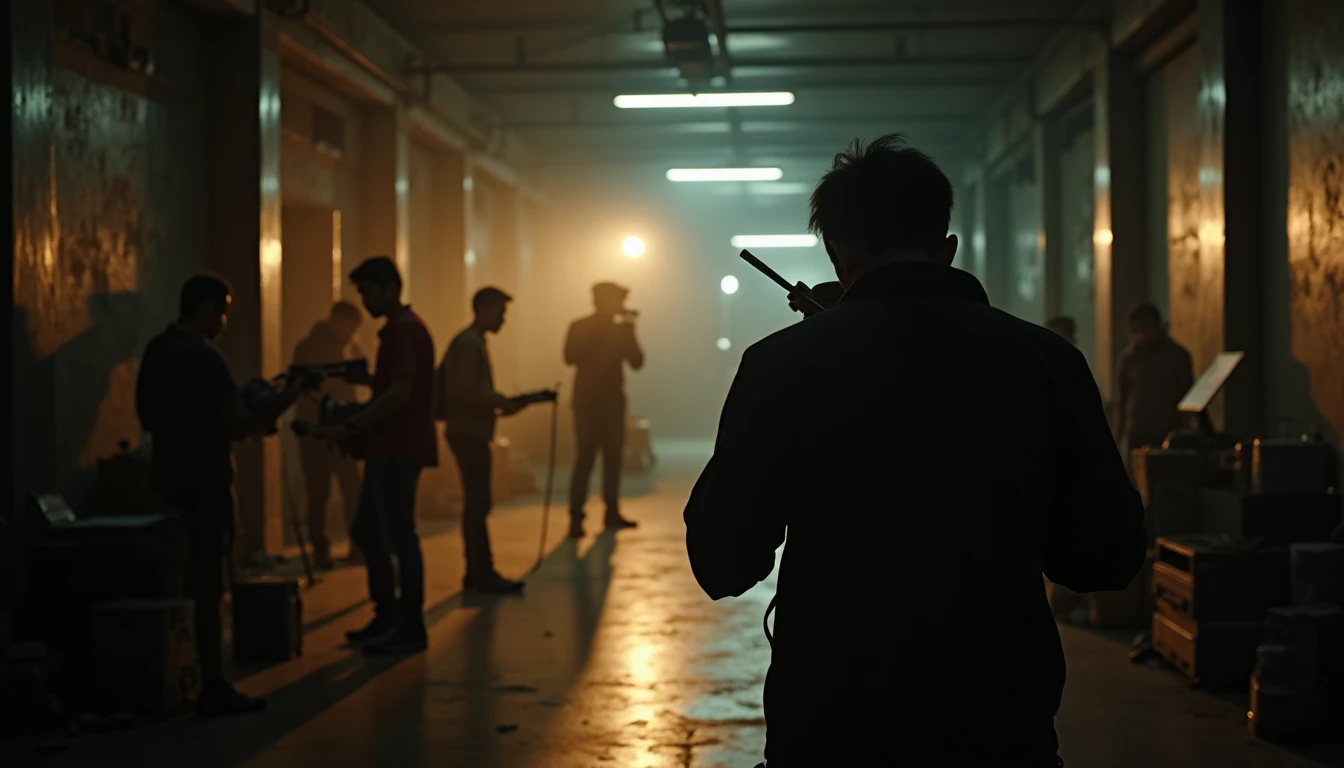
Last month, we had a shoot day that felt like two days. Our goal was to finish a company profile video for a client in one of Semarang’s industrial areas. The original plan was to wrap everything in 8 hours. The reality? We only finished at 2 a.m., a total of 18 hours on location.
This isn’t a story about failure; it’s about the often unpredictable reality behind the scenes of video production. We learned a lot about the importance of a realistic schedule, managing stamina, and keeping the team’s spirits up when things start getting tense.
It all started at a factory in the Kawasan Industri Candi (Candi Industrial Estate), Semarang. At 8:00 a.m., our team was ready with a Sony FX3 camera, a Lumix S 24-105mm f/4 lens, and Aputure Amaran 200x lighting. The first goal was to film detail shots of the production machinery and an interview with the director.
The first problem came up during the lighting setup. The factory floor was huge, and the natural light from the big windows turned out to be quite hard to balance. We needed extra time to place an Aputure Amaran 150 RGB and two Amaran COB 60x lights to get consistent lighting without distracting shadows. That ate up almost two hours of the schedule.
Then our main interviewee, the director, could only show up at 10:30 a.m. We had scheduled the interview for 9:00. The delay pushed back the whole interview schedule that followed. We tried to use the time by shooting B-roll in other areas, but there was still pressure as the clock kept ticking.
After the interview, we had to move to the client’s head office in the Banyumanik area. The drive took about 45 minutes. There, we had to set up all over again for the second interview with the HR manager and for shots of the office atmosphere.
This is where the team’s stamina started to feel drained. The air in Semarang that afternoon was scorching, and we were on the move nonstop. We took turns holding the camera, moving tripods around, managing cables. The chatter between us started to die down, replaced by focus on each person’s own job. You could feel the team’s energy slowly running thin.
Shooting at the office had its own challenges too. Several scenes needed retakes because of noise from outside the room, or because the interviewee wasn’t comfortable with their first gestures. Every retake, however small, felt like it was eating into the precious little time we had left.
We only finished the second interview session around 6:00 p.m. That meant we had already blown past our shooting time target set that morning. On top of that, we still had to get extra shots in the lobby and of the office exterior before it got dark.
That’s when small moments started to happen. One team member bought coffee and snacks for everyone. A simple gesture, but it meant a lot for morale. We reminded each other to drink enough water and take a breather. Our conversations shifted from technical talk to cheering each other on.
We decided to prioritize the most important scenes that had to be finished that night. The office exterior shots were done quickly under the streetlights, making do with whatever light there was. The videographers worked in parallel: one prepared the camera while another set up whatever extra lighting we could manage.
We’re grateful that our client was very cooperative. They understood the conditions on the ground and gave us flexibility. Without their understanding, this long day could have been much worse. Their attitude was a reminder of how important good communication with the client is.
Finally, around 2:00 a.m., we packed up all the equipment. The relief was enormous, but so was the deep exhaustion. Still, looking at the footage we’d gathered, the tiredness was worth it. We had managed to get solid material for the company profile video.
From this experience, I learned three crucial things:
- A Realistic Schedule: Always allow extra time for every segment. Account for the possibility of late interviewees, lighting setups that take a while, or moving between locations. Never assume everything will go as smoothly as it does on paper.
- Managing the Team’s Stamina: Video production is teamwork. Make sure everyone on the team has enough time to rest, eat, and drink. Provide snacks or energy drinks if possible. Keep communicating so the team feels supported.
- Flexibility and Adaptation: A plan is a guide, not a rigid rule. Be ready to adapt to changing situations on the ground. Sometimes, the most creative solutions come precisely from unexpected obstacles.
We proved that long shooting hours don’t always mean a worse end result. With careful preparation (even if it sometimes runs over), solid teamwork, and a never-give-up mentality, we got this tough job done. The experience also gave us valuable footing when we went back to the studio for editing, ready to piece the story together from the footage we’d collected.
If there’s one thing I’d like to pass on from that 18-hour day, it’s this: a loose schedule isn’t the sign of a slow team, it’s the sign of a team that has run over before and learned from it. Late interviewees, lighting setups that slip, changing locations: those aren’t exceptions, that’s a normal shoot day. Only one thing makes the difference in the end result: whether all of those possibilities were factored in from the start, or only noticed when the clock reads nine at night.
Need a visual production team for a project in Semarang? Labstory is a production house based in Semarang. See Labstory’s portfolio for examples of our work, or get to know our team and approach.
FAQ
How long does company profile video production usually take?
The length of company profile video production varies a lot, depending on the complexity of the concept, the number of shooting locations, the length of the interviews, and the visual needs. A simple video can take 2-3 working days. But a more complex production like the story above can take longer, even several weeks if you count pre-production (concept, script, storyboard) and post-production (editing, color grading, sound design).
How do you keep the team’s stamina up during a long shoot?
The key is planning. Set aside enough rest time, provide enough food and drink, and make sure the team gets enough sleep before the shoot day. Open communication matters too; if a team member is feeling exhausted, talk through a solution together.
What are common obstacles when shooting a company profile?
Common obstacles include late interviewees, bad weather (for outdoor shoots), technical problems with equipment, shooting locations that are hard to access or have time limits, and the challenge of getting the shots you want to match the concept.
How do you make a realistic shooting schedule?
Include buffer time for every segment. Account for travel time between locations, time to set up and pack down equipment, and possible retakes. Involve the production team in drawing up the schedule to get more accurate estimates.


Leave a Reply